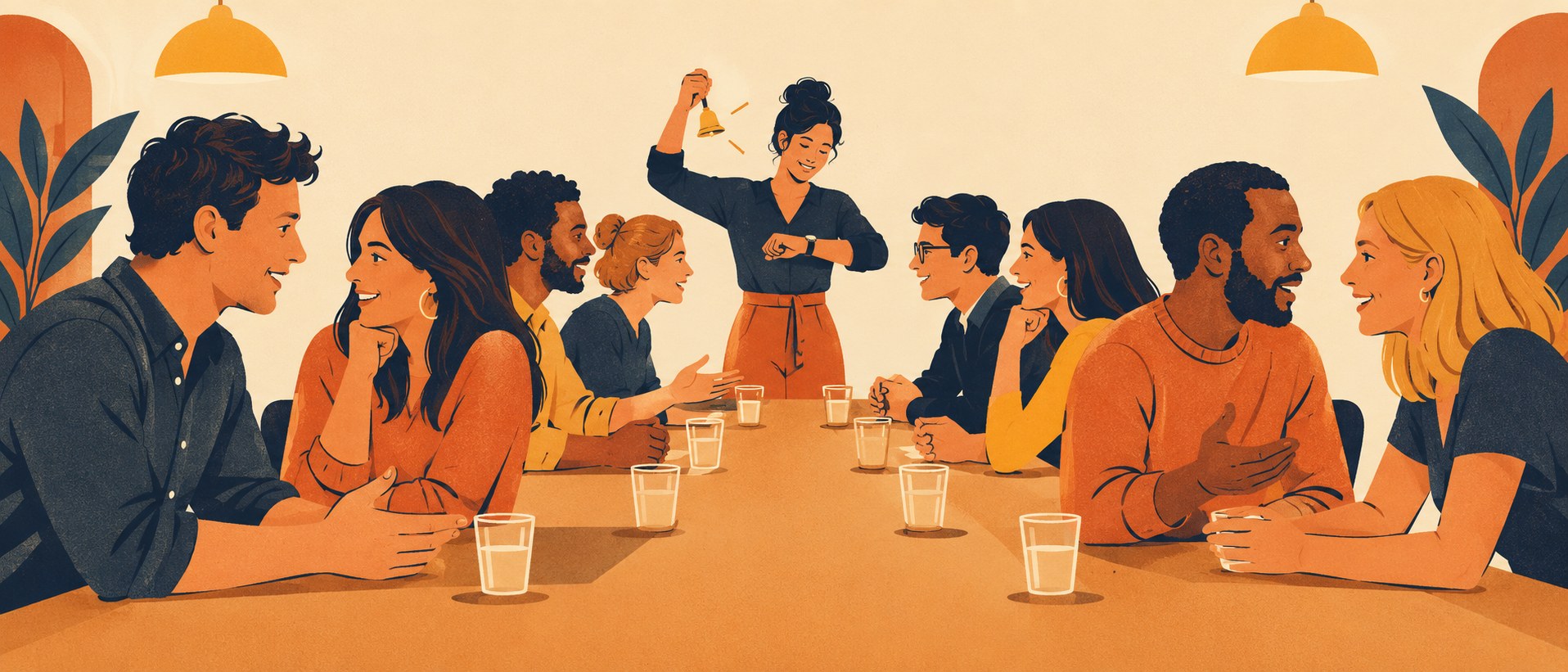
Structured conversation events for strangers in Dallas. No forced vulnerability, no networking-event energy, no expectations. Just better conversations than "how's work."
Get on the listWhen's the last time you had a genuinely good conversation? Got to really talk about yourself, or actually hear someone else's story? Our brains are wired to crave that kind of novelty and surprise, it's part of why a good conversation with a new person can leave you feeling better than almost anything else that happened in your week.
Bigger Small Talk isn't about small talk for its own sake or forced networking. The goal is a genuinely good conversation with someone new, brief, low-stakes, and worth showing up for on its own. And if some long-term friendships form along the way (which they often will), even better.
And every round is timed, so if a conversation isn't flowing with one person, you're not stuck, a new round with someone new is just a few minutes away.
You don't need a study to tell you that most conversations with strangers stay shallow. But it's worth knowing that the discomfort you might feel about that is backed by real research, and so is the payoff on the other side of it.
We're in the middle of a measurable loneliness problem. The U.S. Surgeon General's 2023 advisory found that about half of U.S. adults report feeling lonely, and that chronic loneliness carries health risks comparable to smoking 15 cigarettes a day. Between 2003 and 2020, the average time Americans spent in person with friends fell from about 60 minutes a day to just 20 minutes, a two-thirds decline.
And yet connection is the thing that actually predicts a good life. The Harvard Study of Adult Development, the longest-running study of adult life in the world, tracking the same people since 1938, found that the quality of a person's relationships is a better predictor of long-term health and happiness than money, fame, social class, or even IQ.
The catch is that we're bad at predicting how much we'll enjoy it. Behavioral scientist Nicholas Epley at the University of Chicago ran a series of experiments where train and bus commuters were asked to strike up a conversation with the stranger next to them. The people who did it reported a significantly better commute than those who sat in silence, but beforehand, they'd predicted the opposite. We consistently underestimate how much a real conversation with a stranger will do for us, which is probably the single biggest reason we don't have more of them.
It gets better: we're not just wrong about how much we'll enjoy it, we're wrong about how much the other person enjoys us. Researchers call it the "liking gap." After a conversation, people consistently underestimate how much their conversation partner liked them and enjoyed their company, and this holds true whether the conversation lasts five minutes or several months. So if you walk away from a conversation worrying you talked too much, or that it was awkward, or that they were just being polite, the data says you're almost certainly being harder on yourself than they are.
That's the gap this is built to close. Not by forcing anything, just by making the first step (the awkward, "how do I even start this conversation" step) someone else's job instead of yours.
Introverts. Extroverts. People who just moved to Dallas and haven't built their circle here yet. People whose friend group has quietly shrunk as life's gotten busier. Anyone who loves hearing other people's stories, wants to try something new, wants to get better at real conversation, or just wants to do something a little outside their comfort zone. Honestly, whatever brought you here, there's a good chance you'll leave glad you came.
No prep, no "what do I even say." You don't need a plan, we've got one.
Each round, you're paired with someone new. You'll get a choice of a few conversation starters, pick whichever one actually sounds interesting to you. No obligation to stick with a question that doesn't click, grab another one instead.
Long enough to actually get somewhere, short enough that it never feels like you're stuck. When time's up, you switch to someone new.
Early rounds are easy, low-stakes questions. As the night goes on, the questions get a little more interesting. Nobody's asking you to get deep and personal in round one.
A little shift in energy partway through, a few of you together, one shared conversation.
A short closing conversation, just reflecting on one thing that stuck with you from the night. Then the structured part's over, and if you want to keep talking to someone you met, that's exactly the point.
Skip a question. Pick a different one. Make up your own. Step away for a minute if you need to. Nothing here requires you to share more than you're comfortable with.
This isn't a support group and it isn't group therapy. But it also isn't a networking mixer where everyone's trying to make the best impression. We've built in guardrails so you can actually be a little more open than you'd be at a party, without it ever feeling like you're on the spot.
The whole point of this is real conversation, and real conversation only happens when people don't feel exposed. Most of us clam up around strangers because we're worried about being judged, oversharing, or getting stuck with someone who takes it somewhere uncomfortable. Structure is what removes that risk. It's the same reason a good icebreaker works better than "so, tell me about yourself" — a little bit of scaffolding actually makes people more willing to open up, not less.

A few years ago I came across a news article about a 1997 psychology study by Arthur and Elaine Aron. It explored a simple question: could a specific list of 36 questions, asked in order and going deeper as you go, build real closeness between two people in under an hour? I tried it with my wife, mostly out of curiosity.
We got through five questions.
Five questions turned into a few hours of the kind of conversation we hadn't had in a long time. I was hooked. I started putting together my own question sets to use with friends and family. Every time, the conversation went somewhere better than "how's work."
That sent me down a rabbit hole into understanding how community and human interaction make us happier, but why we're lonelier than ever, even though most of us are surrounded by people and technology built to keep us "connected." Connection isn't a survival need like food, water, or sleep, but it might as well be.
I wanted to figure out an accessible way to bring people together for a positive experience. Then I came across Theodore Zeldin, a British historian and philosopher who founded Oxford's Muse Foundation. For decades, he's brought thousands of strangers together for dinner and conversation built around a carefully designed "menu" of questions. It took the difficult parts of meeting someone and knowing what to talk about out of the equation, and I realized I wanted to start something similar in Dallas.
That's mostly the reason this exists and we'll see where it goes.
— Brandon
Feel free to connect with me! (LinkedIn)
Before we ask anything, here's why we're asking: we use a few details to help pair you with people you're more likely to actually connect with, not to match you romantically, and not to box you in. You can skip anything you're not comfortable answering.